

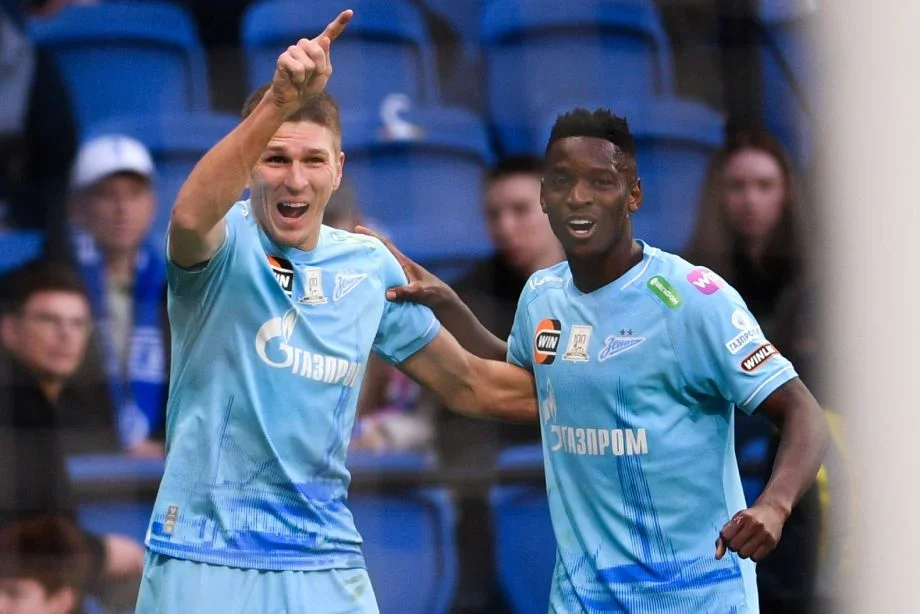
When spring arrives, Luis Henrique becomes royalty. While Champions League fans associate this with PSG and their manager, another Luis Henrique—the one at Zenit—has taken center stage in the Russian Premier League. In the last three RPL matches against Akhmat, CSKA, and Sochi, he has scored more goals (three) than he managed in the previous year and a half (two). His surge has propelled Zenit to the brink of the title.

Zenit 2–1 Sochi
0:1 Fedorov (31′)
1:1 Henrique (59′)
2:1 Erokhin (84′)
*Current RPL table: Can Zenit still lose the championship?*
Multiple factors converged to ignite Henrique’s spring revival. The first is the looming 2026 World Cup and the injury to Chelsea’s Estevão, who will miss the tournament. Both players operate in similar positions, and Estevão’s absence not only boosts Henrique’s chances of making Brazil’s squad—it pushes him closer to the starting lineup. After Brazil’s autumn match against Chile, the Brazilian segment on X (formerly Twitter) erupted: “Finally, we saw a real Brazilian player!” Power, technique, and fluidity—qualities Henrique has always possessed—have now come to the fore since he saw a clear path to national team duty.
The second reason is tactical. Zenit has evolved from simply using Henrique as a traditional winger cutting inside for shots. They now utilize him as a playmaker. Henrique excels at one-touch layoffs (as seen in the third goal against Dynamo) and delivers driving low crosses across the width of the penalty area—a classic Brazilian flank move.
Henrique is not alone in this style. One of his competitors for Brazil’s squad, Ryan from Bournemouth, was signed as a typical winger but has shown a peculiar habit: receiving the ball on the right, carrying it inside, then suddenly switching play with his left foot across the full width. For European coaches, this seems illogical—why gain an advantage on one flank only to shift the ball instantly? But the Brazilian logic is that it destabilizes the opponent’s compactness, creating gaps at the far post or for second balls.
This spring, Zenit has regularly employed these switches and penetrating passes after Henrique drifts centrally. And this leads to the third key factor: chemistry. Lefty wingers Luis Henrique and Maxim Glushenkov now play side by side without stepping on each other’s toes. Henrique likes to move from the flank to the center and shift play to the other wing; Glushenkov does the opposite—drifting from the center toward the right flank. Their partnership has flourished, eliminating any positional competition.
What makes this particularly interesting is that Zenit now has a left-footed conveyor belt—something even many top European teams lack. Usually, right-footed players dictate play from the left flank to the center. But at Zenit, when the ball moves right to left, it travels from Henrique to Douglas Santos (also motivated by World Cup hopes). When it moves left to right, it goes from Douglas Santos to Glushenkov. Their crosses and deliveries into the box are the main source of danger.
Of course, Zenit has been fortunate in the title race that Carlo Ancelotti took note of Henrique and that Estevão’s injury lit a fire under him. Still, the forward’s spectacular month raises paradoxes: If a motivated Brazilian looks this good, why do we see it so rarely at Zenit? If the club relies on personal motivation from national team ambitions, is it wise to bet on such players? Will Henrique remain this driven after the World Cup in North America ends?
These are questions the club must answer once its centenary celebrations are over.
*Previous tactical analysis by the same author:*
– The Main Difference Between Zenit and Krasnodar: Two Completely Different Approaches in the Title Race
– A Typical RPL Goal: One That Would Drive Arne Slot Crazy
